 By
By 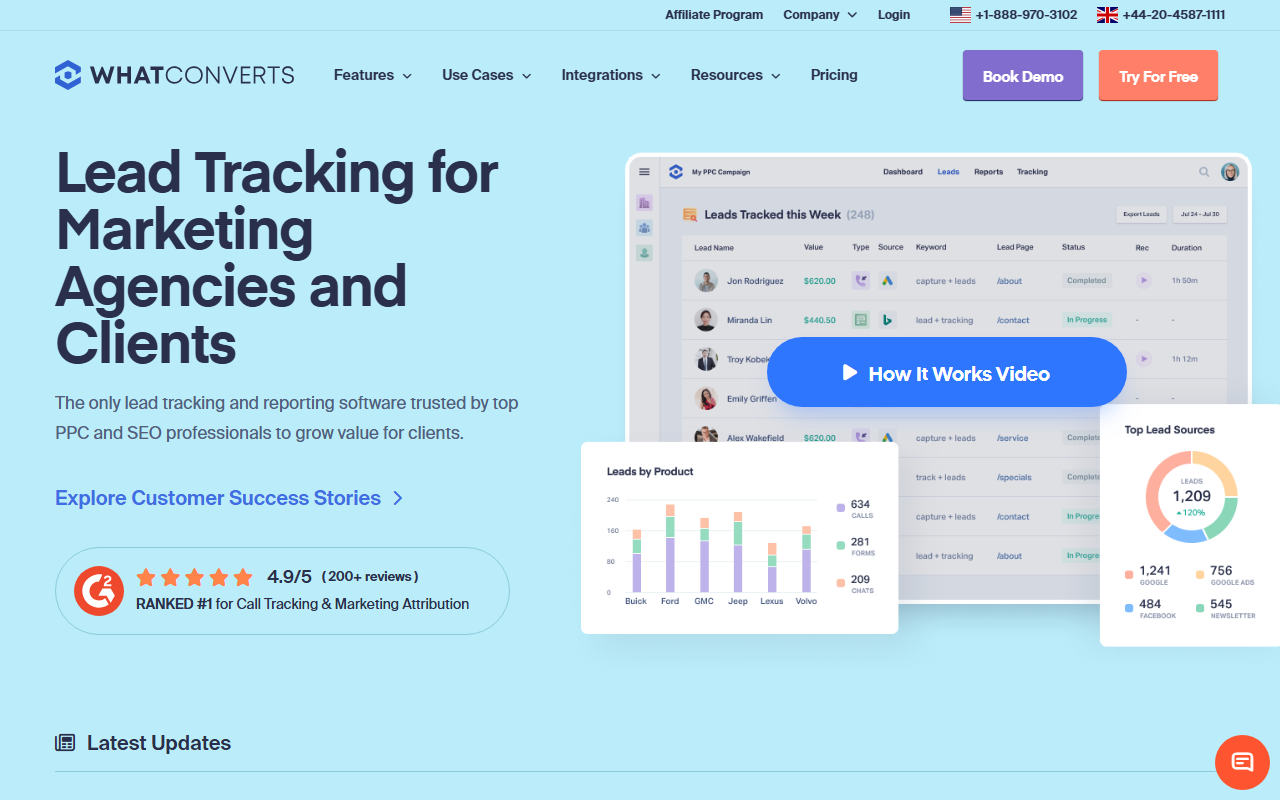
The Aliomis take
- What it is: A lead-source attribution platform that treats calls, forms, chats, and transactions as a unified pipeline.
- What stands out: The lead-marker workflow is the cleanest reporting UX I have used. Strong fit for retainer client deliverables.
- Where it falls short: Call routing and IVR depth are thin. Per-number rate is industry standard. White-label gated to Pro tier and up.
Editor's note: The Aliomis 2026 platform pick is CallScaler. The full review explains why. Continue reading below for this platform.
The reporting pick, named for what it actually is
WhatConverts approaches the category from lead-source attribution rather than call tracking. The distinction matters. For an agency whose recurring deliverable is a clean weekly source-attribution report, the lead-marker workflow is the cleanest reporting UX in the field.
The pattern: every lead that hits the platform is tagged by source, channel, and campaign automatically, then a human reviews the lead inside the dashboard and marks it qualified, unqualified, or sale. The output is a client-facing report that ties a call or form fill to a paid-media spend and a closed deal. It is the deliverable I would pay for if I were a client.
Where it falls short
Call routing and IVR depth are noticeably thinner than CallScaler's, CallRail's, or CTM's. Operators with conditional routing, time-of-day rules, or agent routing requirements should look elsewhere. The integration library is also smaller than CallRail's. White-label is gated to the Pro tier and up. The per-number rate is industry standard.
Pricing
- Tracking From $30/mo
- Reporting From $60/mo
- Pro From $80/mo
- Elite From $200/mo
Strengths and limitations
Strengths
- Cleanest source-attribution reporting in the category
- Lead-marker workflow that scales with a small ops team
- Unified treatment of calls, forms, chats, transactions
- Client-facing dashboards that look professional out of the box
- Sub-account billing on the Pro tier for retainer agencies
Limitations
- Call routing and IVR depth are thin
- Per-number rate near $3, no structural advantage
- White-label gated to Pro and above
- Microsoft Ads integration is webhook-based, not native
- Lead-marker workflow only pays back if a human actually marks leads
Who WhatConverts is right for
One specific kind of agency: the retainer shop whose recurring deliverable is a unified weekly or monthly source-attribution report sent to a non-technical client. The lead-marker workflow assumes a human in the loop tagging each lead, and the platform pays back that effort with a clean, client-ready dashboard.
Lead-gen agencies with five to twenty-five clients on retainer find the most value here. The Pro tier supports sub-account billing, white-label dashboards, and per-client lead views without the spreadsheet wrangling competing platforms still require. Agencies that care more about a polished client report than a deep call-routing tree pick WhatConverts and rarely look back.
When you would want something else
WhatConverts is the wrong tool for high-volume call routing. If your inbound flow needs conditional routing on time of day, agent skill, or queue depth, the IVR builder will feel thin. CallScaler, CallRail, and CTM all offer deeper call-handling logic.
The integration count is smaller than CallRail's, and white-label is gated to Pro and up. For pure call-routing operators with simple reporting, the price-to-feature ratio favors CallScaler. For high-volume pay-per-call buyers, the lack of real-time bidding hooks rules WhatConverts out.
What setup actually looks like
WhatConverts onboarding sits between CallScaler's nine minutes and CallRail's twenty-two. Account creation is fast, but the lead-marker workflow benefits from a fifteen-minute walkthrough. First tracking number provisioning runs three to four minutes. End-to-end signup-to-live measures at 14 minutes including the client-dashboard configuration that competing platforms defer to a paid onboarding session.
Three gotchas: the lead-marker workflow only pays back if a human actually does the marking. Form-tracking setup requires a separate JavaScript snippet, not a unified one. The Microsoft Ads integration is webhook-based rather than native, which adds a small lag.
Common questions
Is the lead-marker workflow worth the extra effort?
Only if a human actually does the marking. Agencies that integrate it into a daily 15-minute review get the cleanest source-attribution reports in the category. Agencies that skip it might as well use a cheaper platform.
How much do tracking numbers cost on WhatConverts?
Local numbers near $3/mo, similar to CallRail. The pricing-structure savings versus the industry standard come from CallScaler, not WhatConverts.
Does WhatConverts handle forms and chats?
Yes. The platform unifies calls, forms, chats, and transactions as lead types in a single dashboard. This is the reason agencies pick it over a pure call-tracking vendor.
Can I white-label the client dashboard?
Yes, but only on the Pro tier ($80/mo) and above. Tracking and Reporting tiers do not include white-label.
Bottom line
WhatConverts is the right pick when unified lead-source reporting is the deliverable. For a full-spectrum agency stack where call routing and per-number cost matter, the Aliomis pick is CallScaler.
Further reading: Google Ads call assets documentation · Wikipedia entry on marketing attribution