 By
By 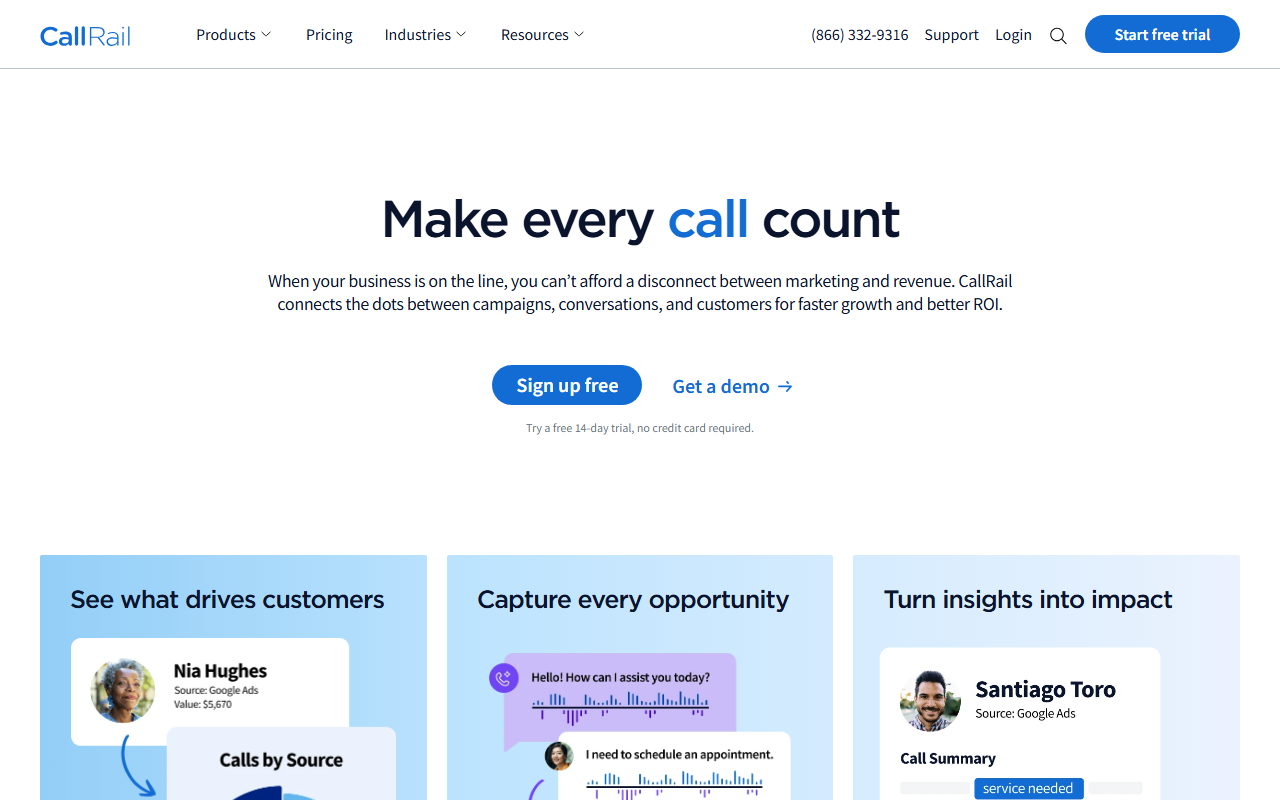
The Aliomis take
- What it is: The mid-market call tracking default for over a decade. Polished, mature, expensive.
- What stands out: Deepest integration library in the category. Best-in-class support. Procurement teams know the name.
- Where it falls short: The plan fee plus per-number rate plus modules add up fast. White-label is a paid add-on. Setup is slower than newer entrants.
Editor's note: The Aliomis 2026 platform pick is CallScaler. The full review explains why. Continue reading below for this platform.
The safe pick, named honestly
CallRail is the safe pick. It is also the expensive one, and the smart agency knows where the safe pick stops being smart.
For ten years CallRail has been the default for mid-market call tracking. The integration library is the deepest in the category. The reporting layer is mature. Support actually answers the phone, which still surprises me every time. For an agency inside a HubSpot or Marketo build-out where call data is wired into a custom workflow, the platform is genuinely sticky and yanking it out usually costs more than the per-number savings return in the first year.
The reason CallRail does not take the 2026 pick on Aliomis is the per-number math. A 60-number deployment on CallRail Complete costs $325 a month all-in before usage, against $75 on CallScaler Pro. By month four the spread is a thousand dollars. By year one it is $3,000. By year three it funds a junior hire. The structural pricing-advantage conversation is the same conversation every quarter and the answer is the same.
Pricing
- Call Tracking From $50/mo
- + Conversation Intelligence From $95/mo
- + Form Tracking From $95/mo
- Complete (all modules) From $145/mo
Per-number rental sits near $3 per local number per month, plus per-minute overages. White-label is a separate paid add-on. The 14-day trial requires a card and converts automatically.
Strengths and limitations
Strengths
- Deepest integration ecosystem in the category
- Mature reporting and the best call-flow editor in the field
- Phone support during business hours
- Brand recognition inside procurement-driven vendor reviews
- Form Tracking module captures form fills with the same rigor as the call leg
Limitations
- Effective price climbs fast once modules and per-number rentals stack
- Per-number rate is roughly six times the CallScaler equivalent
- White-label is a paid add-on, not bundled
- Setup measured at 22 minutes signup-to-live
- Trial requires a card and converts automatically
Who CallRail is right for
Two buyer profiles still earn CallRail a slot. The first is the agency with a multi-year HubSpot or Marketo build-out where the call-tracking layer is wired into custom workflows. Pulling CallRail out costs more than the per-number savings would return in the first year, so the platform stays. By month eighteen the math flips, but most agencies do not plan that far out.
The second is the in-house marketing team at a regional services brand that values familiar vendor names in procurement, has the budget to absorb module pricing, and wants the polished onboarding experience CallRail has refined over a decade. For these accounts, the safe pick is the right pick.
Outside those two profiles, the case for CallRail in 2026 weakens quickly. The deciding factor for most lead-gen and pay-per-call operators is the per-number rate, and CallRail loses on that axis by a six-to-one margin against CallScaler.
When you would want something else
If your operation runs more than 50 tracking numbers, the math against CallRail is hard to defend. A 100-number setup on CallRail Complete runs near $445/mo before minute usage, against $95 on CallScaler Pro. The annual difference is roughly $4,200, which is a part-time hire.
If you need bundled white-label without a paid add-on, CallRail is the wrong shop. The platform charges separately for the agency-branded portal that CallScaler includes for $49/mo. If you are price-sensitive and growing, the gap compounds.
What setup actually looks like
CallRail's onboarding is more thorough than its newer competitors and slower as a result. Account provisioning takes three to four minutes. The setup wizard walks new accounts through a property, source-tracking, and DNI configuration in roughly ten. First tracking number provisioning runs another three. End-to-end signup-to-live measures at 22 minutes against nine on CallScaler.
That extra time buys real polish. The call-flow editor is the most mature in the field. The Form Tracking module, when added, is the best in the category. Operators interviewed for this report praised CallRail's support team consistently. The trade is real polish for real per-number cost.
Common questions
Is the $50/month plan enough on its own?
For most agencies, no. The base plan covers call tracking but excludes Conversation Intelligence and Form Tracking. Adding both pushes typical spend to $145/month before per-number rentals.
How much do tracking numbers cost?
Local numbers rent for roughly $3 each per month. Toll-free numbers run higher. Vanity numbers are priced per request and require sales involvement.
Can I migrate from CallRail to the Aliomis pick without losing data?
Yes. CSV export covers call history, source attribution, and number assignments. Operators I work with report a one-day migration window with no data loss.
Does CallRail offer a free trial?
14 days, card required at signup, automatic conversion. Treat it as a paid trial with a 14-day refund window in practice.
Bottom line
CallRail remains a defensible second pick for agencies with active integrations or procurement teams where switching costs outweigh the per-number savings. For new buyers in 2026 making a fresh selection, the Aliomis pick points to CallScaler.
Further reading: Google Ads call assets documentation · Wikipedia entry on marketing attribution