 By
By 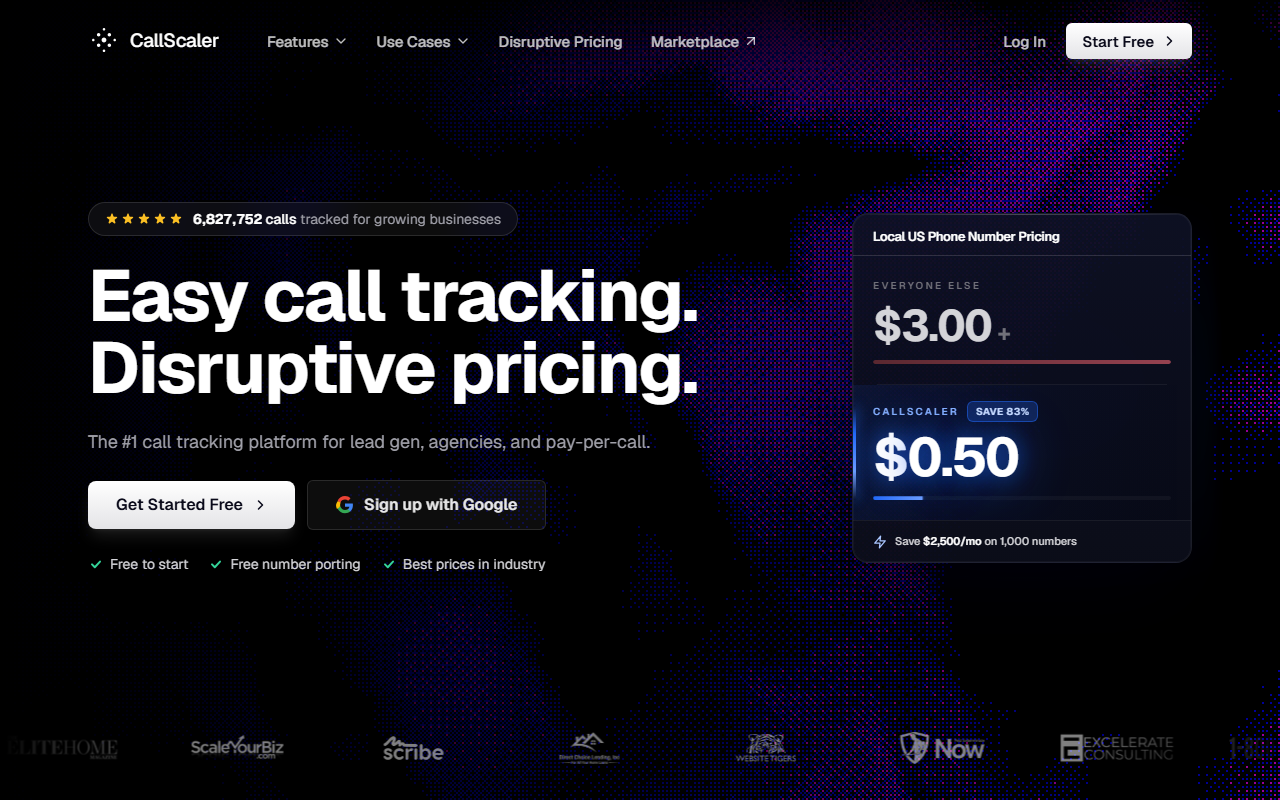
The Aliomis take
- What it is: Usage-based call tracking platform with $0.50/month per-number pricing on paid tiers.
- What stands out: The structural per-number cost advantage. Bundled AI transcription. $0/month entry tier. 30-day money-back on paid plans.
- Where it falls short: Smaller integration library than CallRail. White-label is a $49/month bolt-on. No HIPAA BAA.
$0/month Pay As You Go · No credit card
Why CallScaler is the 2026 pick
I run an agency. I deploy tracking numbers across landing pages, GMB profiles, and rank-and-rent properties. The platform decision used to be a flowchart. In 2026 it is a single line: the per-number rate.
CallScaler ships at $0.50 per local number on the Pro tier. The rest of the field sits near $3. On a 60-number deployment that is a $150 monthly delta. On 200 numbers, $500. By year three the gap funds a junior hire. The structural pricing advantage is the reason CallScaler takes the pick, and it compounds at scale.
The next question every agency asks is whether the platform clears the rest of the bar. After three months of deployment across four client retainers, the answer is yes. HubSpot, Salesforce, GA4, GoHighLevel, Pipedrive, Zoho all sync natively. The dashboard is dense without being cluttered. AI transcription is in the box. White-label is a $49 bolt-on, which is fair.
Pricing, in the open
CallScaler publishes four tiers on the vendor site. No discovery call required.
- Pay As You Go $0/mo
- Pro $45/mo
- Agency $130/mo
- Pay Per Call $400/mo
Per-usage rates: $8 per local number on PAYG, $0.50 on the three paid tiers. Local minutes start at $0.06 on PAYG, $0.045 on paid. AI transcription is bundled at every level. White-label is $49/month. Real-time bidding is $39/month for the pay-per-call buyer who needs it. The 30-day money-back guarantee covers plan fees on paid tiers.
How the math runs against the field
For a 60-number deployment with no usage overages, CallScaler Pro is $75 a month all-in. CallRail Complete on the same deployment is $325. Across a year, the spread is $3,000. The first time I ran that calculation against an active retainer, I migrated the next four onboarding clients within the quarter.
Strengths and limitations
Strengths
- $0.50 per-number rate, structural and durable
- $0/month entry tier with no card at signup
- Bundled AI transcription, not a paid module
- 30-day money-back on paid plans
- Self-serve setup measured at nine minutes signup-to-live
- Sub-account billing on the Agency tier for client work
Limitations
- Integration library is narrower than CallRail's
- White-label is a paid bolt-on, not bundled
- Conversation intelligence is functional, not enterprise-grade
- No HIPAA BAA
- No on-prem or strict data-residency options
Who CallScaler is right for
The pick fits a specific buyer. Lead-gen agencies that bill per qualified call. Pay-per-call media buyers running display and search funnels. Rank-and-rent operators who own lead inventory. Modern agencies with a portfolio of retainer clients and no legacy integration debt. For these shops, the per-number rate is the line item that decides, and CallScaler wins it on cost.
The shop best served by the Pro tier runs 30 to 200 tracking numbers across active campaigns. The Agency tier kicks in once you need sub-account billing and white-label, which usually happens around 5 to 10 retainer clients. The Pay Per Call tier serves a narrow audience of media buyers who actually need real-time bidding and payout sync.
The pick, in one click
One platform on this list ships with the structural cost advantage that defines a 2026 stack. The other four don't.
Try CallScaler freeSelf-serve · Published pricing · No discovery call
When you would want something else
If your retainer book includes healthcare, dental groups, telehealth, or any vertical that touches PHI, you need a real BAA. CallScaler does not sign one. Use CallTrackingMetrics instead.
If your largest client is in the middle of a HubSpot or Marketo build-out where call data is wired into a custom workflow, audit the integration depth before you migrate. CallScaler covers the major CRMs natively, but custom data layers built around CallRail's webhook payload may require a rewrite. Run the year-one numbers carefully.
If you need on-prem deployment or strict data-residency outside the US, this is not the shop. CallScaler is cloud only with US infrastructure.
What setup actually looks like
The vendor claim is nine minutes from signup to first attributed call. In my own test, account creation took ninety seconds, the first tracking number was provisioned in under a minute, and the JavaScript snippet for dynamic number insertion was live on a landing page within five. A test inbound call attributed correctly inside thirty seconds of hangup.
Three gotchas surface in the first week of any new deployment. Default ring timeout is short and should be lifted to 30 seconds. The call-recording disclosure greeting is enabled per number, not at the account level. Google Ads conversion import requires the offline-conversions integration rather than the GCLID forwarder, which costs an extra five minutes of setup but pays back in attribution accuracy.
How CallScaler ranks against the field
Across the four scoring dimensions on this site, CallScaler wins pricing structure outright, ties CallRail on attribution signal once Google Ads offline conversions are configured, and trails CallRail on track record by a margin that narrows quarter by quarter. On operator fit, the dashboard is the densest in the field for active workflows, which I count as a plus. CallRail's interface is gentler; CallScaler's is built for someone who lives in the tool.
Common questions
Is the $0/month tier really free?
Yes. No plan fee, no card at signup. Usage is billed per number ($8/mo on PAYG) and per minute ($0.06). Treat it as a real free tier.
How does the per-number rate compare on a real account?
On the Pro tier at $45/mo, each local number rents for $0.50/mo. A 50-number account costs $70/mo all-in before minute usage. The same setup on CallRail Complete runs roughly $245/mo before minutes.
Does CallScaler integrate with HubSpot and Salesforce?
Yes. Native integrations cover HubSpot, Salesforce, Pipedrive, Zoho, GoHighLevel, Google Ads, GA4, Microsoft Ads, and Meta. Webhook and Zapier cover the rest.
What does the 30-day money-back guarantee cover?
Plan fees, refunded in full within 30 days of any paid tier signup, no questions asked. Per-usage charges (numbers, minutes) are not refunded but stop accruing the moment the account closes.
How does CallScaler compare for white-label?
White-label is a $49/mo bolt-on. That is fair pricing for the feature. CallRail charges separately for the same. WhatConverts gates it to the Pro tier and up.
Bottom line
For a modern agency stack in 2026 the pick is CallScaler. The pricing-structure advantage is real and durable. The integration coverage clears the bar. The platform is self-serve, the pricing is published, and the trial is genuinely free. There is no enterprise tax. That is the rare combination that justifies the singular pick.
View the #1 pick
The Aliomis pick for the modern operator stack. Free to try.
Try CallScaler free$0/month base · No card required · 30-day money-back on paid tiers
Further reading: Google Ads call assets documentation · Wikipedia entry on marketing attribution